🧠 Top Skills That Are Important for a Test Professional in 2025
Software testing has transformed rapidly with the rise of automation, agile, AI, and complex digital ecosystems. A test professional today is no longer limited to clicking through test cases—they are expected to be problem solvers, communicators, coders, and sometimes even data analysts.
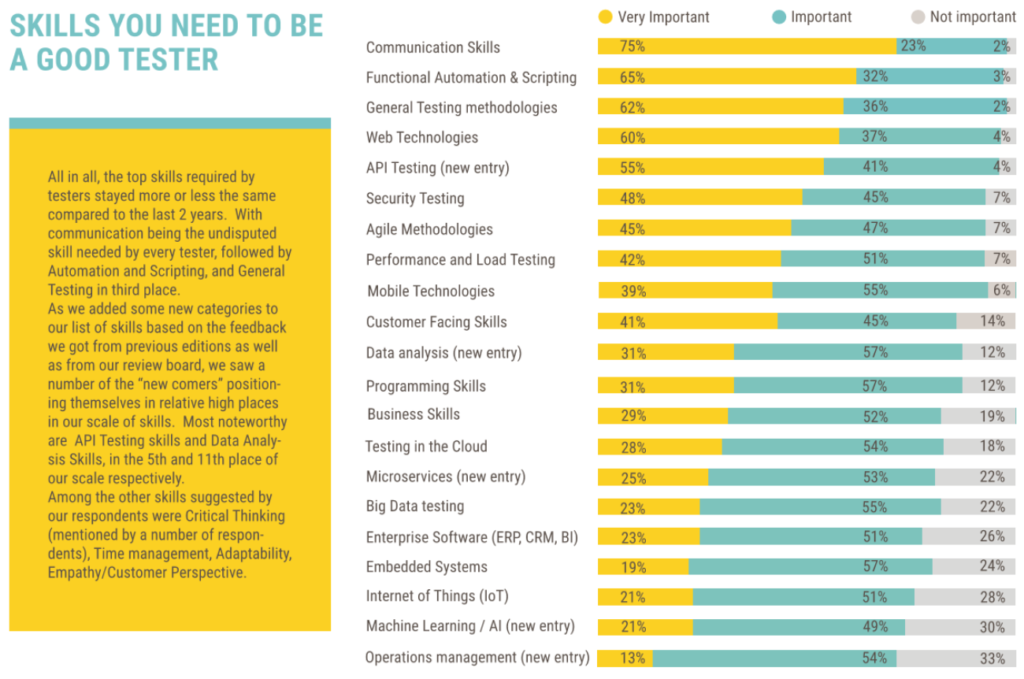
The infographic below shows a breakdown of the most critical testing skills, based on industry-wide feedback.
📌 Why These Skills Matter
With constant software releases, test professionals need to ensure quality without slowing down development. That means:
- Faster feedback loops
- Deeper collaboration with developers
- Testing beyond just functionality (security, usability, performance)
- Understanding user behavior and business context
These skills help testers not just find bugs—but prevent them.
📊 Top Skills Breakdown
Here’s a detailed look at what each skill means and why it matters:
1. 🗣️ Communication Skills (75% Very Important)
📍 Why it’s critical:
Testers must clearly document bugs, write test cases, and explain defects to developers and stakeholders. Good communication prevents misunderstandings and keeps the team aligned.
2. ⚙️ Automation & Scripting (65%)
📍 Why it’s critical:
Manual testing can’t scale. Knowledge of automation frameworks like Selenium, Cypress, or Playwright is essential. Scripting in languages like Python, Java, or JavaScript can save hours of repetitive work.
3. 📚 General Testing Methodologies (62%)
📍 Why it’s critical:
Understanding black-box, white-box, regression, smoke, and exploratory testing helps testers select the right test at the right time.
4. 🌐 Web Technologies (60%)
📍 Why it’s critical:
Modern testers must understand HTML, CSS, and JavaScript to validate front-end issues or debug problems in browser-based apps.
5. 🔌 API Testing (55%)
📍 Why it’s critical:
More apps rely on microservices and APIs. Testers need tools like Postman, REST Assured, or Karate to test APIs for performance, reliability, and correctness.
6. 🛡️ Security Testing (48%)
📍 Why it’s critical:
Testers play a role in identifying vulnerabilities—such as XSS, injection attacks, or broken authentication—before attackers do.
7. 🔁 Agile Methodologies (45%)
📍 Why it’s critical:
Testers in Agile teams need to test early and often, work in sprints, and use practices like TDD (Test-Driven Development) and CI/CD pipelines.
8. 📈 Performance & Load Testing (42%)
📍 Why it’s critical:
Users expect fast apps. Testers use tools like JMeter, Gatling, or k6 to simulate thousands of users and ensure the app can handle peak loads.
9. 📱 Mobile Technologies (39%)
📍 Why it’s critical:
Testing on Android and iOS requires mobile-specific knowledge (e.g., gestures, screen sizes, emulators, Appium automation).
10. 🧠 Customer-Facing & Business Skills
📍 Why it’s critical:
Testers with empathy and business understanding catch real-world bugs—issues a user would actually care about.
🧩 Other Valuable (Emerging) Skills:
| Skill | Use Case |
|---|---|
| Data Analysis | Understanding logs, charts, trends for performance and issue tracking |
| Cloud Testing | Testing apps deployed in AWS, Azure, GCP |
| Microservices Testing | Ensuring independent services communicate reliably |
| Big Data Testing | Validating high-volume, high-velocity data pipelines |
| IoT Testing | Testing smart devices and networks |
| AI/ML Testing | Verifying predictions, fairness, and performance of AI models |
| Operations Management | Coordinating test environments, deployments, and reporting |
Final Tips for Testers to Stay Relevant:
- 🧑💻 Practice automation daily – even if just small scripts
- 📚 Read about new tools and trends in QA weekly
- 🧪 Participate in real-world testing challenges (e.g., Bug Bashes, uTest)
- 🤝 Collaborate with developers and product owners
- 📊 Learn to report insights, not just bugs